
If you’re a runner in Seal Beach dealing with persistent knee pain, you’ve probably heard the standard advice: “It’s just all that pounding on the pavement. Maybe try softer surfaces.”
So you switch to the beach strand. You run the packed sand near the water’s edge. You avoid concrete altogether. And yet… the knee pain running in Seal Beach continues. Sometimes it even gets worse.
Here’s what most runners don’t realize: while impact matters, the actual cause of runner’s knee—medically known as patellofemoral pain syndrome—usually has very little to do with the hardness of the surface you’re running on. In fact, for many Seal Beach runners, the beach itself might be contributing to the problem in ways you’d never expect.
What Is Runner’s Knee (And Why Does It Hurt)?
Patellofemoral pain syndrome (PFPS) is the most common cause of knee pain in runners. It presents as a dull, aching pain behind or around your kneecap that gets worse when you:
- Run or walk downhill
- Climb stairs (especially going down)
- Squat or kneel
- Sit with bent knees for extended periods
According to the American Academy of Orthopaedic Surgeons, PFPS occurs when the kneecap doesn’t track properly in its groove as your knee bends and straightens. This misalignment creates increased pressure and irritation between the back of your kneecap and your thigh bone.
But here’s the critical part most runners miss: the root cause isn’t your kneecap. It’s almost never your kneecap.
The Real Culprits Behind Running Knee Pain in Seal Beach
Research consistently shows that runner’s knee is primarily caused by weakness and imbalances in the muscles that control your kneecap’s movement—specifically your hip and thigh muscles.
1. Weak Hip Abductors and External Rotators
Your hip muscles—particularly your glutes—play a crucial role in stabilizing your pelvis and controlling how your thigh bone rotates. When these muscles are weak, your thigh bone rotates inward excessively during running, which forces your kneecap out of its proper groove.
This creates that characteristic anterior knee pain that worsens with activity. No amount of softer running surfaces will fix weak hips.
2. Quad Muscle Imbalances
The quadriceps muscles on the front of your thigh work together to keep your kneecap centered. When the inner quad (vastus medialis oblique) is weak compared to the outer quad muscles, your kneecap gets pulled to the outside—exactly the misalignment that causes patellofemoral pain.
3. Training Errors That Seal Beach Runners Make
Living in Seal Beach means access to incredible running routes, but it also means unique training pitfalls:
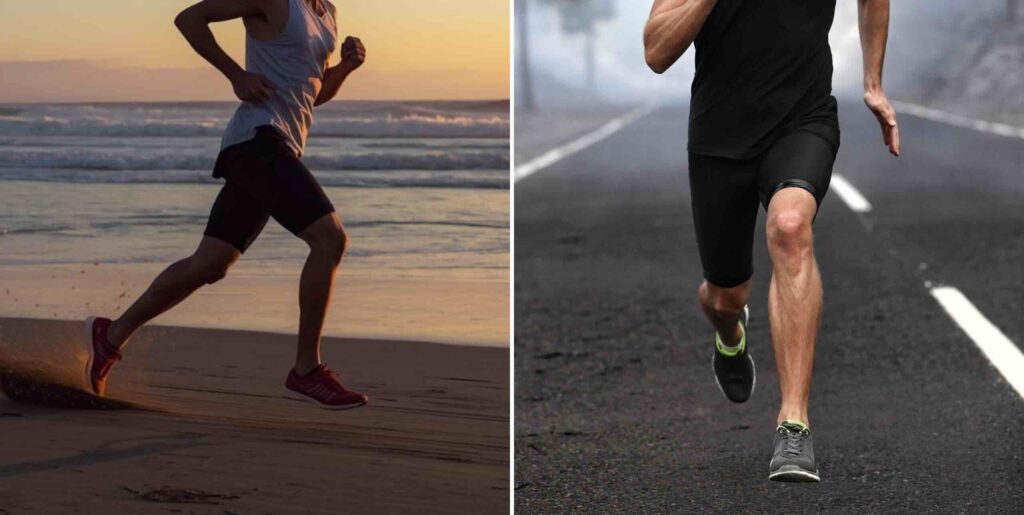
The Beach Strand Camber Problem: The Seal Beach beach strand has a natural slope from the dunes down toward the water. When you run the same direction repeatedly, one leg is always slightly higher than the other. This leg-length discrepancy forces your body into compensatory movement patterns that stress your knees differently—particularly the downhill knee.
Sand Running Instability: While many runners assume the soft sand along Seal Beach will help their knee pain running, research published in the Journal of Science and Medicine in Sport shows that unstable surfaces like sand actually require significantly more work from your stabilizing muscles. If your hip and core muscles are already weak, adding beach running can overload them further and worsen knee pain.
PCH Training Intensity Jumps: Running Pacific Coast Highway is flat and fast, which tempts many Seal Beach runners to suddenly increase their pace or mileage. These sudden changes in training intensity are one of the primary triggers for developing patellofemoral pain syndrome.
Why Blaming the Pavement Misses the Point
Here’s a common scenario we see at our Seal Beach physical therapy clinic: A runner develops knee pain running on pavement. They switch exclusively to beach running, thinking the softer surface will solve everything. Three weeks later, they’re in more pain than before.
What happened?
The beach’s uneven, unstable surface exposed the real problem: weak hip stabilizers and poor single-leg control. The pavement wasn’t causing the knee pain—it was just the context where compensatory movement patterns became painful.
Impact force does matter, but your body is designed to handle it. What your body can’t handle is repetitive poor movement patterns driven by muscle weakness and imbalances.
The Seal Beach Running Landscape: What You Need to Know
Let’s talk specifically about how local running conditions affect knee pain:
Running the Seal Beach Pier to Long Beach Strand
This is one of the most popular routes in the area—beautiful, relatively flat, and scenic. But the consistent outward camber of the beach strand means you’re essentially running on a tilted surface for miles. If you always run the same direction, you’re setting yourself up for overuse injuries.
The fix: Alternate your running direction every other run. If you ran north to Long Beach yesterday, run south from the pier toward Sunset Beach today.
Beach Sand vs. Packed Wet Sand
Dry, soft sand requires 1.6 times more energy expenditure than firm surfaces due to the instability and reduced muscle-tendon efficiency. This means that while beach running feels easier on impact, it’s actually demanding significantly more from your hip flexors, glutes, and stabilizing muscles.
If those muscles are already weak (which they likely are if you have runner’s knee), beach training can accelerate fatigue and worsen biomechanical breakdowns.
The fix: Use beach running strategically—short intervals on soft sand for strength work, not long steady runs when you’re already dealing with knee pain.
Pacific Coast Highway and Road Running
Many Seal Beach runners love the PCH route for its flat, fast character. But continuous running on predictable, hard surfaces without adequate hip and core strength means every stride reinforces the same faulty movement pattern thousands of times.
The fix: Don’t avoid roads entirely, but address the underlying weakness and movement dysfunction first.
How to Tell If Your Knee Pain Running in Seal Beach Needs Professional Help
Not all knee pain requires physical therapy, but certain signs indicate you need expert assessment:
- Pain that persists beyond 2 weeks despite rest
- Pain that consistently returns within a few runs of resuming training
- Clicking, popping, or grinding sensations in your kneecap
- Pain that worsens going downstairs or downhill
- Weakness or instability when landing on one leg
- Pain that affects your daily activities, not just running
What Actually Fixes Runner’s Knee
If reducing impact isn’t the answer, what is? Evidence-based treatment for patellofemoral pain syndrome focuses on:
Targeted Hip Strengthening: Specifically hip abduction and external rotation exercises that restore proper pelvic control during running.
VMO (Inner Quad) Activation: Specialized exercises that strengthen the vastus medialis oblique to properly stabilize the kneecap.
Movement Pattern Correction: Identifying and retraining the compensatory strategies that led to the pain in the first place. This requires expert video analysis and real-time feedback.
Joint-by-Joint Assessment: Understanding how mobility restrictions or strength deficits elsewhere in your kinetic chain—like stiff ankles or a weak core—are contributing to your knee pain running.
Progressive Return to Running: A structured plan that rebuilds your running tolerance while reinforcing proper biomechanics.
Simply resting and then returning to the same training that caused the problem will result in the same outcome. Runner’s knee requires addressing the root cause—and that means specialized physical therapy that understands running biomechanics.
The Seal Beach Running Community Deserves Better
Too many runners in Seal Beach accept knee pain as an inevitable part of training. They modify their routes, reduce their mileage, give up races they’d trained months for—all because they were told their knees “can’t handle the impact.”
The truth? Your knees are designed to handle running. But they need the right support system—strong hips, stable pelvis, proper quad activation, and biomechanically sound movement patterns.
That’s what specialized sports physical therapy provides: not just symptom management, but identification and correction of the actual dysfunction causing your pain.
Get Back to Running the Seal Beach Strand Pain-Free
At MOTUS Specialists Physical Therapy in Seal Beach, we specialize in treating runners with persistent knee pain that hasn’t responded to rest or traditional approaches. Our doctorate-level physical therapists use our proprietary 4P Joint by Joint Approach® to identify the true source of your patellofemoral pain—whether it’s hip weakness, ankle mobility restrictions, or movement pattern dysfunction.
We’re not interested in keeping you out of running for months. Our goal is to get you back to training on the beach strand, along PCH, or wherever you love to run—stronger, faster, and without pain.
Located in Seal Beach, we serve runners throughout Seal Beach, Long Beach, and Orange County with specialized one-on-one care that professional athletes trust. Each session is dedicated entirely to you, with advanced assessment technology and evidence-based treatment protocols that address your complete kinetic chain.
Stop accepting knee pain as part of running. Call us at (949) 873-0012 or visit motusspt.com to schedule your comprehensive running assessment and discover why your knee pain isn’t just from the pavement – and how we can fix it.