
Surfing Seal Beach? Here’s How to Avoid Shoulder Injuries Local PTs See Most
If you surf Seal Beach regularly, you already know the magic: clean peaky waves on the north side of the pier when conditions are right, those rare barrel-heavy south side sessions when a big winter swell hits, or the long rights at Ray Bay when the south swell wraps just perfectly into the San Gabriel River mouth.
But there’s a less magical reality that every surfer in Seal Beach eventually confronts – shoulder pain.
Whether you’re catching mellow longboard waves at the north side of the pier, charging those hollow back-breaking barrels when the south side fires, or paddling out at the jetty for a punchy shortboard session, your shoulders are doing serious work. And for many surfers in Seal Beach, that work eventually leads to the most common chronic injury in the sport: surfer’s shoulder.
Here’s what local physical therapists who specialize in treating surfers see most often – and more importantly, how you can prevent it from sidelining your sessions in Seal Beach.
What Is “Surfer’s Shoulder”?
“Surfer’s shoulder” isn’t a formal medical diagnosis, but it’s the term surfers use to describe the constellation of shoulder problems that develop from repetitive paddling. Medically, these injuries typically involve:
- Rotator cuff tendinitis or tears – inflammation or damage to the tendons of the four muscles that stabilize your shoulder
- Shoulder impingement – compression of rotator cuff tendons in the narrow space beneath your shoulder blade
- Scapular dyskinesis – abnormal movement patterns of your shoulder blade
- Subacromial bursitis – inflammation of the fluid-filled sacs that cushion your shoulder
According to research published in Sports Medicine – Open, chronic shoulder injuries related to the rotator cuff occur in approximately 80% of surfers who experience shoulder complaints. This makes shoulder issues the single most common chronic injury surfers face.
The reason? Paddling. Lots and lots of paddling.
Why Surfing in Seal Beach Creates Shoulder Problems
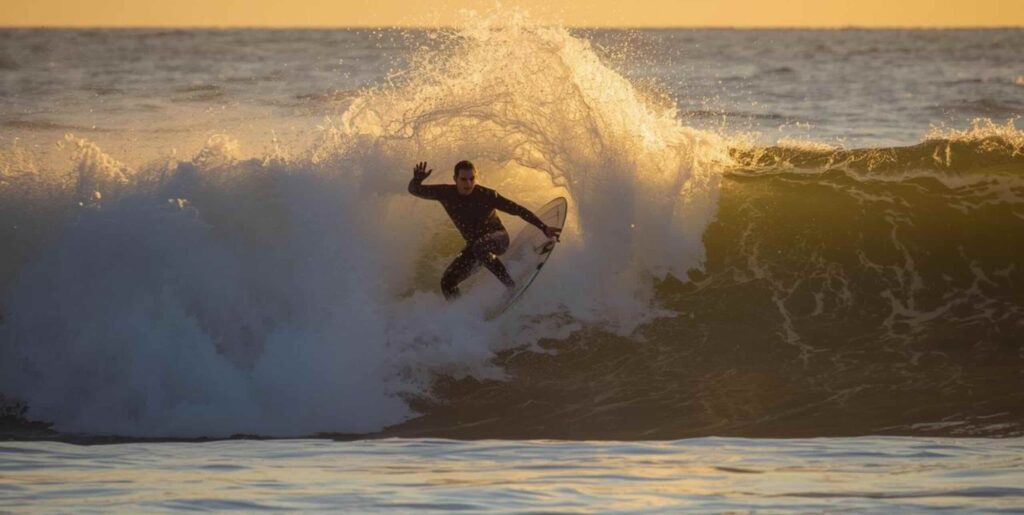
Studies show that surfers spend roughly 50% of their time in the water paddling – that’s hundreds, sometimes thousands of paddle strokes per session. Between getting out through the lineup, positioning for waves, duck diving, and catching waves, your shoulders are under constant repetitive stress.
Surfing in Seal Beach specifically presents certain factors that can intensify shoulder strain:
The South Side Barrel Chase
When the south side of the Seal Beach pier lights up with those rare, powerful winter WNW swells, it’s one of the most exciting surf experiences in Orange County. Surfer magazine once described conditions there as “back-breaking madness” – steep, hollow waves that break close to shore, capable of pounding you directly into the sand.
Charging these waves requires aggressive paddling to get into position quickly, repeated duck diving through powerful closeout sets, and explosive paddle-ins to catch fast-moving waves before they barrel. This intensity dramatically increases the load on your rotator cuff muscles – especially if you’re not conditioned for it.
The Long Paddle Out
Most spots in Seal Beach require sustained paddling to get outside, particularly when there’s solid swell. Unlike point breaks where you can use a channel, beach breaks demand repeated paddle-duck dive-paddle sequences that accumulate serious shoulder fatigue, especially for surfers who don’t train their shoulders specifically for endurance.
The Winter Wetsuit Factor
Seal Beach water temperatures drop to 55-61°F in winter, requiring 4/3mm or even 5/3mm wetsuits. Research shows that thicker wetsuits restrict shoulder mobility and require more force to complete each paddle stroke, increasing the demand on your rotator cuff muscles and accelerating fatigue.
The Biomechanics: Why Paddling Destroys Shoulders
Here’s what’s actually happening to your shoulders when you paddle in Seal Beach:
The Muscle Imbalance Problem
When you paddle, you’re primarily using your internal rotator muscles (especially the subscapularis) and your chest muscles (pectoralis major and minor) to pull through each stroke. These muscles become overdeveloped and shortened.
Meanwhile, your external rotators – the infraspinatus and teres minor muscles of your rotator cuff – are barely active during the power phase of paddling. They’re only briefly engaged when your arm comes out of the water to recover forward. This creates a dramatic strength imbalance.
According to research on shoulder injuries in surfing, professional surfers show significantly greater internal rotation strength compared to external rotation strength, with the non-dominant arm’s external rotators being particularly weak.
The Postural Distortion
When you’re lying on your surfboard paddling in Seal Beach, your body assumes a very specific position: neck and thorax in extension (looking forward), lower back arched in lordosis, shoulders rolled forward. Hold this position for 1-2 hours per session, multiple times per week, and your body starts to adapt to it – even on land.
This posture causes:
- Forward shoulder protraction
- Scapular winging (shoulder blades sticking out)
- Reduced space beneath the acromion (top of shoulder blade)
- Impingement of the supraspinatus tendon
Studies show scapular dyskinesis – abnormal shoulder blade movement – is present in 71.4% of surfers, with many showing visible winging even at rest.
The Supraspinatus Vulnerability
The supraspinatus muscle is part of your rotator cuff, and its tendon passes through an extremely narrow space called the subacromial space. When you raise your arm overhead – like during each paddle stroke – this space becomes even narrower.
If your shoulder blade isn’t moving correctly (dyskinesis) or your internal rotators are too tight, the supraspinatus tendon gets pinched repeatedly. Over time, this causes inflammation, degeneration, and eventually tears.
The Signs You’re Developing Surfer’s Shoulder
Many Seal Beach surfers ignore early warning signs until the pain becomes debilitating. Here’s what to watch for:
Early Stage:
- Mild aching in the front or side of your shoulder after sessions
- Stiffness when reaching behind your back
- Clicking or popping sensations (without pain) during arm movement
- Fatigue during paddle-outs that seems worse than usual
Moderate Stage:
- Pain during duck dives or aggressive paddling
- Difficulty getting your arm comfortably overhead
- Pain that lingers for hours or days after surfing
- Weakness when paddling – you feel like you’re not generating power
Advanced Stage:
- Sharp pain that stops you mid-session
- Inability to sleep on the affected shoulder
- Pain with everyday activities (reaching for objects, putting on shirts)
- Visible difference in shoulder position or movement compared to the other side
If you’re experiencing moderate to advanced symptoms, it’s time to see a physical therapist who specializes in surfers – before you’re forced to take months out of the water.
How to Prevent Shoulder Injuries Surfing in Seal Beach
Prevention is exponentially easier than rehabilitation. Here’s what actually works:
1. Address the Muscle Imbalance
The cornerstone of shoulder injury prevention for Seal Beach surfers is strengthening your external rotators – the muscles you’re not using enough when paddling.
External Rotation Exercises: Use resistance bands to perform external rotation movements 2-3 times per week. Focus on the infraspinatus and teres minor muscles. Higher reps (15-20) with moderate resistance build the endurance these muscles need for long sessions.
Scapular Stabilization: Your shoulder blade’s movement is crucial. Exercises like scapular retractions, YTWs, and prone shoulder raises strengthen the muscles that control your shoulder blade position – preventing the winging and dyskinesis that lead to impingement.
2. Stretch Your Internal Rotators
Your chest and front shoulder muscles are chronically tight from paddling. Doorway pec stretches, sleeper stretches for internal rotation, and lat stretches should be performed daily – not just after surfing, but throughout the day to counteract the adaptation your body is making to paddling posture.
3. Improve Thoracic Extension
Limited upper back mobility forces your shoulders to compensate with more movement, increasing injury risk. Foam rolling your thoracic spine, thoracic extension exercises over a foam roller, and rotational mobility work help maintain the upper back extension you need for proper shoulder mechanics.
4. Progressive Conditioning
Here’s a common scenario in Seal Beach: Flat spell for two weeks, then a solid south swell hits. You surf for three hours on day one, another two hours that evening, and you’re back out for a dawn patrol the next morning. Your shoulders, which have done minimal work for 14 days, suddenly get hammered with 6+ hours of intense paddling in 24 hours.
This load spike is a recipe for injury. Build up progressively – use resistance training and swimming during flat spells to maintain shoulder conditioning so you’re ready when Seal Beach fires.
5. Technique Matters
Poor paddling mechanics amplify injury risk. Common technical errors include:
- Crossing your arms too far inward at the end of each stroke (increases internal rotation demand)
- Not engaging your core, forcing your shoulders to do all the work
- Hunching your shoulders toward your ears during paddling (increases trap dominance and shoulder elevation)
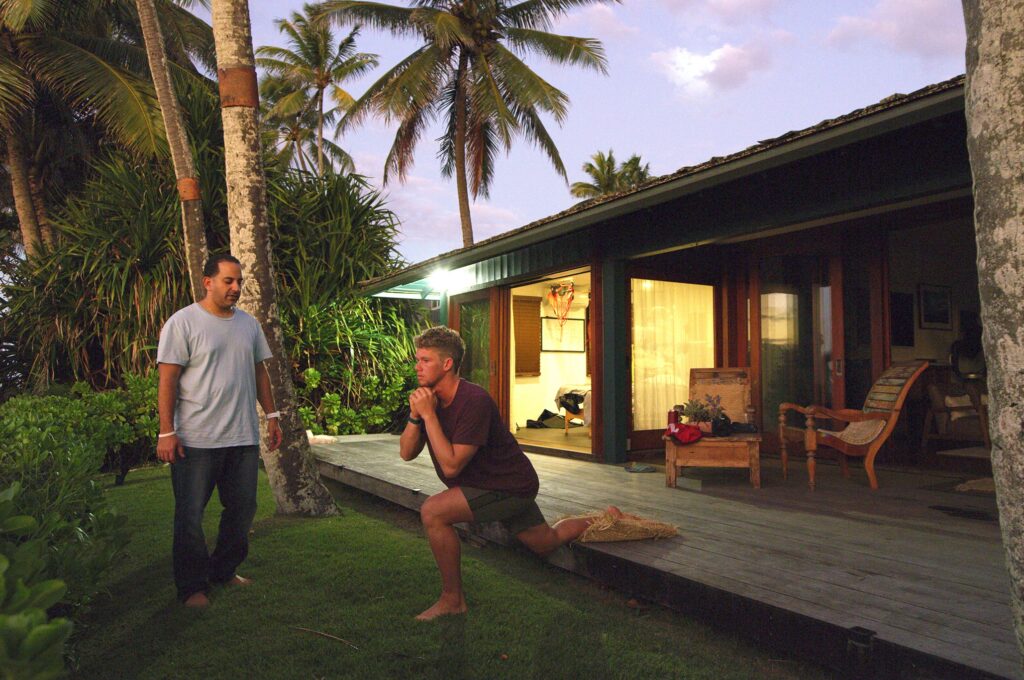
A physical therapist experienced with surfers can analyze your paddling technique and identify specific corrections.
When Seal Beach Surfers Need Physical Therapy
Sometimes prevention isn’t enough. Maybe you ignored early symptoms, maybe you’re coming back from a wipeout injury, or maybe years of surfing have finally caught up. Here’s when it’s time to see a surf-specialized physical therapist:
- Shoulder pain that persists more than 2 weeks despite rest
- Pain that returns within a few sessions every time you start surfing again
- Weakness or instability you can feel when paddling
- Limited range of motion that’s affecting your ability to paddle or pop up
- Any grinding, catching, or locking sensations in your shoulder
Why Surf-Specific Physical Therapy Matters
General physical therapy clinics might help, but treating surfer’s shoulder effectively requires understanding the sport’s unique biomechanical demands. A physical therapist who works with surfers knows:
- The specific muscle imbalances paddling creates (internal vs. external rotator strength ratios)
- How scapular dyskinesis differs in surfers compared to other overhead athletes
- The postural distortions specific to prone paddling position
- How to assess and correct paddling technique
- Return-to-surf progressions that get you back in the water safely
The best physical therapists for surfers don’t just treat your shoulder – they analyze your entire kinetic chain. Hip mobility restrictions, core weakness, and even ankle stiffness can all contribute to compensatory shoulder mechanics that lead to injury.
Elite Surfer Physical Therapy Available in Seal Beach
Physical therapists who’ve worked with the world’s best surfers understand shoulder injuries at a level that translates directly to weekend warriors surfing in Seal Beach. The techniques used to keep professional competitive surfers healthy through grueling contest seasons – intensive paddle training, massive swells, and international travel – are the same approaches that work for local surfers dealing with chronic shoulder pain.
Working with elite athletes requires precise biomechanical assessment, advanced manual therapy skills, and evidence-based treatment protocols that get results efficiently. When a physical therapy practice has experience treating WSL competitors and surf legends, it signals a level of expertise that benefits every surfer who walks through the door.
Whether you’re a grom on the north side learning to surf, an intermediate surfer chasing south side barrels when they fire, a longboarder catching rights at Ray Bay, or a seasoned Seal Beach local dealing with years of accumulated wear and tear, specialized physical therapy can keep you in the water.
The Seal Beach Surf Community Deserves Expert Care
Seal Beach has a special surf culture. From the mellow longboard days on the north side to those rare, firing south side sessions that draw surfers from across Orange County, from the jetty’s punchy peaks to Ray Bay’s long rights – these breaks have produced generations of dedicated wave riders.
But shoulder pain shouldn’t be an inevitable part of surfing in Seal Beach. With proper preventive training, early intervention when symptoms arise, and access to surf-specialized physical therapy, you can surf these waves for decades without chronic injury.
The key is treating surfer’s shoulder as the biomechanical problem it actually is – not just resting, icing, and hoping it goes away. Address the muscle imbalances, improve your scapular control, restore proper shoulder mechanics, and you’ll paddle stronger, surf longer, and stay pain-free in Seal Beach.
Get Back to Surfing Seal Beach Without Shoulder Pain
At MOTUS Specialists Physical Therapy in Seal Beach, we’ve built our reputation on treating surfers at the highest level. Our team has worked with surf legends including like Mick Fanning, John John Florence, Kolohe Andino, Crosby Colapinto and Griffin Colapinto (The Cola Bro’s) elite athletes who’ve pushed the boundaries of what’s possible on a surfboard.
That same expertise is available to the local Seal Beach surf community. We understand the unique demands of surfing in Seal Beach – the powerful south side barrels, the long paddle-outs, the jetty peaks, the specific muscle imbalances that paddling creates. Our doctorate-level physical therapists use our proprietary 4P Joint by Joint Approach® to identify the true source of your shoulder pain and create a targeted treatment plan that addresses your entire kinetic chain.
Whether you’re dealing with rotator cuff tendinitis, shoulder impingement, chronic pain from years of surfing, or you simply want to prevent injury before it happens, we provide one-on-one care with the advanced assessment and treatment techniques that professional surfers rely on.
Located in Seal Beach, we serve the local surf community with specialized physical therapy that gets you back in the water – stronger, healthier, and ready to charge when the conditions are firing.
Stop letting shoulder pain keep you out of the lineup. Call us at (949) 873-0012 or visit motusspt.com to schedule your 60-minute surf-specific shoulder assessment and get back to surfing Seal Beach pain-free.